
Should pastors even talk about this?
When people hear that I, as the pastor of a local church, speak on the issues of the day, I often hear things like, “I don’t think politics should be addressed from the pulpit.” I understand where that comes from. Nobody wants church to feel like a campaign rally. I have some theories as to how we got to this place; nonetheless, that statement is not the historical norm.
The silence from the “moral majority” is evident at the ballot box. Prior to the 2024 election, George Barna’s Cultural Research Center estimated that 32 million Christians who are regular churchgoers were likely to stay home on Election Day (Crosswalk). The top reasons given were a lack of interest in politics (68%), disliking both major candidates (57%), and believing their vote wouldn’t make a difference (52%). They also found that barely more than half of churches even encouraged their congregants to vote (Arizona Capitol Times).
Think about that for a moment. Nearly half of our churches would not even say, “Go vote.”
So is this in the realm of the church’s duty, or should it come from somewhere else? What happens if we stay quiet? Where do we draw the line? These are questions worth asking, and I believe the Bible and history give us some clear answers.
Did God’s people serve in government?
Before we get into a US history lesson, look at the Bible. A pattern shows up again and again. God placed His people in positions of public influence, and He used them there.
- Joseph served as Pharaoh’s second-in-command and saved a nation from famine (Genesis 41:39–43).
- Daniel served under pagan kings for most of his life and never compromised. But Daniel purposed in his heart that he would not defile himself (Daniel 1:8). He was so faithful in office that his enemies could find no fault in him except concerning the law of his God (Daniel 6:3–10).
- Esther was a queen who used her position to spare God’s people. Mordecai asked her, and who knoweth whether thou art come to the kingdom for such a time as this? (Esther 4:14).
- Nehemiah was the king’s cupbearer and later served as governor in Judah (Nehemiah 1:11; 5:14).
- John the Baptist spoke out against the political leader of his day concerning his immorality. For John had said unto Herod, It is not lawful for thee to have thy brother’s wife (Mark 6:18). It cost him his head, but he did not stay quiet.
- Paul used his Roman citizenship to protect himself and the gospel work, and he appealed to Caesar (Acts 16:37; 22:25; 25:11).
- Moses led a nation and delivered God’s law to it, and David, a king, wrote much of the Psalms.
Even pagan leaders were used by God for His purposes. Nebuchadnezzar was called God’s servant (Jeremiah 27:6). God raised up Pharaoh for this cause (Exodus 9:16). Indeed, The king’s heart is in the hand of the LORD (Proverbs 21:1).
Years ago I was at a meeting that encouraged pastors to get their churches involved. A pastor who had planted a church in Washington, D.C., was speaking. I will never forget something he said. Pastor Brad Wells said, “It is inconceivable that the God who ordained human government would want His people out of it.”
He is right. Paul calls the civil ruler the minister of God to thee for good (Romans 13:4). God is the one who set up government. Why would He want His people to stay out of it?
Scripture even tells us what kind of people to put in office. Jethro told Moses to provide out of all the people able men, such as fear God, men of truth, hating covetousness (Exodus 18:21). And Solomon tells us why it’s important: When the righteous are in authority, the people rejoice: but when the wicked beareth rule, the people mourn (Proverbs 29:2).
When God told Israel what to look for in a king, He said the king could not be a foreigner, could not multiply wives or riches to himself, and had to read God’s law all the days of his life, that he may learn to fear the LORD his God (Deuteronomy 17:15–20). That law was given to Israel, but the character it describes is still what we should look for in a leader.
Now, to be clear, America is not Israel. God made specific promises to Israel that we cannot claim for our nation. However, many of America’s founders drew from the same basic principles outlined for the blessings of Israel, and God indeed blessed. The church’s mission is the Great Commission, not running the government. But the principle in Proverbs 14:34 is for every nation: Righteousness exalteth a nation: but sin is a reproach to any people. Notice the words “any people.” That includes us.
What part did pulpits play in early America?
If someone told a pastor in 1775 that the pulpit should stay out of public life, he would have looked at them like they had two heads.
In colonial New England, the annual election sermon was a regular part of public life. Pastors preached before the legislature on the duties of rulers and the rights of the people. Sermons on liberty and righteous government were common.
One of the best-known is Jonathan Mayhew’s A Discourse Concerning Unlimited Submission, preached in Boston in 1750. Mayhew worked through Romans 13 and asked a hard question. Does God require Christians to submit to a ruler no matter how wicked he becomes? That sermon was printed and read widely for years.
John Adams later looked back and named Mayhew among the men who awakened American principles before the Revolution. He listed Mayhew and Samuel Cooper, another Boston pastor, alongside James Otis, Samuel Adams, and John Hancock as “the most conspicuous, the most ardent and influential” men in that awakening (Adams to Hezekiah Niles, 1818). Long before the Bill of Rights was adopted, those rights were preached with conviction from the pulpits of America.
The British noticed too. Peter Oliver, a Loyalist writing from London, complained about what he called the “black Regiment,” the clergy of Massachusetts who stirred up resistance (Current). This was not a compliment. Many ministers supported the Revolution, encouraging their own members to enlist. Many of them even served as chaplains.
The pattern was still clear decades later. When the French writer Alexis de Tocqueville toured America in 1831, he saw how deeply faith shaped the nation’s public life. He wrote:
Religion in America takes no direct part in the government of society, but it must be regarded as the first of their political institutions; for if it does not impart a taste for freedom, it facilitates the use of it.
…I do not know whether all Americans have a sincere faith in their religion—for who can search the human heart?—but I am certain that they hold it to be indispensable to the maintenance of republican institutions.
Alexis de Tocqueville, Democracy in America, vol. 1 (1835)
What about Baptists?
As a Baptist, this part of the story is close to my heart. Before the Revolution, Baptist preachers in Virginia were jailed for preaching without a license from the state church. Men like Isaac Backus in New England and John Leland in Virginia spent years pressing for religious liberty.
Leland and his fellow Baptists pressed James Madison hard for the protections that became part of the First Amendment. Later, in 1801, the Danbury Baptist Association wrote to President Thomas Jefferson, concerned that their religious freedom was treated as a favor from the government instead of a right from God. Jefferson’s reply in 1802 reiterating the intent of the First Amendment is where we get the phrase “a wall of separation between Church & State” (Library of Congress).
What is interesting about that is the Baptists did not get involved in government to take it over. They got involved to keep the government off the church’s back. They understood that if Christians stay out of public life, someone else will make the rules for them.
Did the founders want faith kept out of politics?
Jefferson’s “wall” was meant to keep the government out of the church. It was never meant to keep Christians out of government. Listen to some of the men who founded this nation.
John Jay wrote five of The Federalist Papers and served as the first Chief Justice of the United States. In 1816 he wrote:
Providence has given to our people the choice of their rulers, and it is the duty, as well as the privilege and interest of our Christian nation, to select and prefer Christians for their rulers.
John Jay to John Murray Jr., 1816
John Witherspoon was a Presbyterian pastor and the only active minister to sign the Declaration of Independence. Weeks before he signed it, he preached:
He is the best friend to American liberty who is most sincere and active in promoting true and undefiled religion.
John Witherspoon, The Dominion of Providence over the Passions of Men, 1776
John Adams told a group of Massachusetts militia officers in 1798:
Our Constitution was made only for a moral and religious People. It is wholly inadequate to the government of any other.
John Adams to the Massachusetts Militia, 1798
These men did not see faith as something to leave at the door of the courthouse or the polling place.
Aren’t these Bible issues, not political ones?
Here is an important fact that churches need to realize. Many of the issues people call “political” were in the Bible long before they were on a ballot. When a pastor preaches on them, he is not wandering off into politics. He is preaching the Book.
Life. God knows a child before birth. For thou hast possessed my reins: thou hast covered me in my mother’s womb (Psalm 139:13). Before I formed thee in the belly I knew thee (Jeremiah 1:5). See also Exodus 21:22–23. God is the giver and taker of life.
Marriage and family. God defined marriage at creation. Therefore shall a man leave his father and his mother, and shall cleave unto his wife: and they shall be one flesh (Genesis 2:24). Jesus pointed right back to that design in Matthew 19:4–6.
Justice and honesty. A false balance is abomination to the LORD: but a just weight is his delight (Proverbs 11:1). God cares about honest dealing, and He calls His people to speak up for those who cannot speak for themselves (Proverbs 31:8–9).
Religious liberty. When the authorities told Peter and John to stop preaching, they answered, Whether it be right in the sight of God to hearken unto you more than unto God, judge ye (Acts 4:19).
In addition to these, I could write an entire paper on all the political things the Bible addresses, including but not limited to: abortion, euthanasia, marriage, sexuality, gender, parental rights, education, pornography, free speech, capital punishment, self-defense, justice in the courts, bribery, human trafficking, racial equality, honesty in leadership, taxes, debt, property rights, work and welfare, honest business, immigration, drugs and alcohol, stewardship of creation, Israel, and war and peace.
When a culture starts calling these things by new names, Isaiah already warned us: Woe unto them that call evil good, and good evil (Isaiah 5:20).
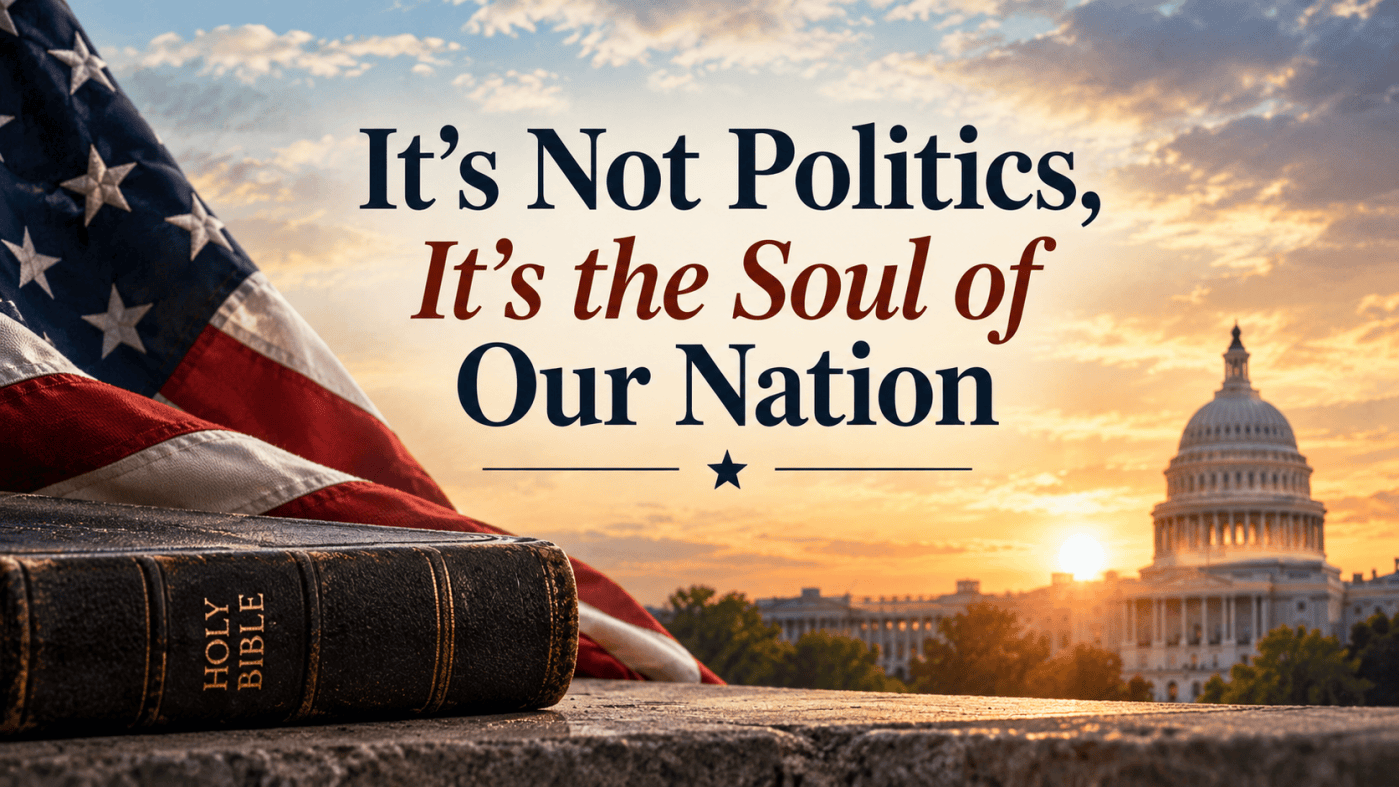
So when someone tells me to stay out of politics, I want to ask some questions. Should I stop preaching Psalm 139? Should I skip Genesis 2? What about Romans 1, or 13? Of course not. These are not party issues. They are Bible issues. It’s not politics. It’s the soul of our nation. The church is not getting political; politics are getting theological. That is indeed our realm.
What can pastors and churches do?
So what does this look like on a Sunday morning? It does not mean turning the service into a political rally, throwing out red hats and merch. It means faithful pastors doing what pastors have always done, and doing it with intentionality.
- Preach the whole counsel of God. When the text speaks to life, marriage, or justice, say what it says. Do not skip it because it feels “political.” In fact, take the truth of the text and plug it into the modern political context so there is no question as to where God stands on the issues. DO NOT do what some progressive churches have done and twist the text to fit our personal agenda. …let God be true, but every man a liar… (Romans 3:4). We must make sure we handle the text properly and submit ourselves to it.
- Pray for our leaders by name. I exhort therefore, that, first of all, supplications, prayers, intercessions, and giving of thanks, be made for all men; For kings, and for all that are in authority (1 Timothy 2:1–2). This is incredibly important. We are told to do so in hopes that we may live quiet and peaceable lives, that we may live out our faith, and ultimately bring others to salvation, which is found in Jesus Christ (see 1 Timothy 2:2–4).
- Remind your people to register and vote. This is the simplest step, and Barna’s research shows that barely half of churches are taking it. Have a “Civic Sunday” voter registration day.
- Help them learn the issues. Make nonpartisan voter guides available. Teach them to weigh a candidate and a candidate’s policies by biblical principles. Teach them what it is to vote their biblical values.
- Encourage them to serve. Some in your pews may be the Josephs and Daniels of our day. School boards, city councils, and local offices need godly people too. Sometimes people do not consider it because they’ve never been challenged that they could be the change. They could even get involved in volunteer efforts that do not require running for office, such as poll watching or door knocking.
- More helps and resources. There are many good resources for churches. Some practical steps and helps can be found at Awake America, My Faith Votes, and FRC’s Watchmen on the Wall.
What has this looked like in our church?
Here are a few things we have done at our church. None of this is complicated, and any church can do it.
We let the text speak to the times. I don’t go looking for a political hook every Sunday. But when the passage I am preaching speaks to an issue of the day, I don’t avoid it. I highlight the biblical principle, and then I show where our society or our politics have drifted from it or where it can be seen in our day. The Bible sets the agenda, not the news cycle. However, sometimes certain things in the news are on everyone’s mind, and people are wondering if the Bible addresses the issue. In those times, it is helpful to go to the Scriptures and simply give God’s mind on the subject, as pastors did in the early days of America.
We pray very specifically. As election season builds, our prayers get specific. We pray for candidates by name, for the issues on the ballot, and for our people to vote with wisdom. Vague prayers are easy to forget. Specific prayers are easy to see answered. Additionally, throughout the year on our Wednesday night prayer bulletin, we include the names of key individuals from the current administration, our state capital, and our local leaders in order to pray for them by name.
We organized a prayer and fasting chain. Leading up to an election, we asked people to sign up for one or more days in an unbroken prayer and fasting chain, starting 30 days out. Every single day, someone in our church was fasting and praying for our nation. Esther did not walk into the king’s court without first calling God’s people to fast (Esther 4:16). It is an intentional way to humble ourselves as we seek God’s face. We are privileged in America to have a government that recognizes that rights come from God. However, if we don’t maintain that recognition by exercising those rights, the time may come when they will no longer be recognized and protected, even in America.
Our men prayed through the night. The weekend before the last presidential election, we held an all-night men’s prayer meeting. Can I tell you, there is something powerful about watching the men of your church on their knees at 3:00 in the morning for their country. The effectual fervent prayer of a righteous man availeth much (James 5:16). Real patriotism requires real sacrifice. We say we love America, but are we willing to give up some meals? Are we willing to lose a night of sleep to appeal to the God of heaven AND of earth?
A word of caution on endorsements
Pastors need to know where the law stands. The Johnson Amendment, passed in 1954, bars 501(c)(3) organizations, including churches, from endorsing candidates. In July 2025, the IRS agreed in a court settlement that churches could endorse candidates to their congregations through normal religious communication (Holtzman Vogel). But on March 31, 2026, a federal judge in Texas rejected that settlement, ruling the court did not have authority to approve it, which leaves the provision in place for now (Catholic World Report). The case is now on appeal at the Fifth Circuit. The IRS and Treasury have said guidance for churches is coming, but none had been issued as of this writing (Christian Century).
What does that mean for us? You can preach on moral issues, encourage voting, and pray for leaders without any concern. Be careful before you endorse a candidate from the pulpit or on church letterhead until the courts or the IRS settle the matter.
One thing that I do in our church is I simply let the church know how I, as a private citizen, am voting. I do not do this from behind the pulpit or during a service. I make the list available for whoever wants it outside of church hours and apart from using church resources.
What about the objections?
Good Christians raise honest concerns about this.
“Our citizenship is in heaven.” Amen. For our conversation is in heaven (Philippians 3:20). But the same Paul who wrote that verse used his Roman citizenship more than once. Being a citizen of heaven does not cancel our responsibility as citizens here. Jesus said, Render therefore unto Caesar the things which are Caesar’s; and unto God the things that are God’s (Matthew 22:21). We, as Christians, have a dual citizenship, and we must be faithful to both.
“The gospel is the answer, not an election.” I agree with that completely. No law will ever change a heart. Only Jesus can do that. Voting does not replace the gospel. A free country where we can preach without interference is worth protecting, and our vote is one way we do it. Vote and pray!
“Politics will divide the church.” It can, if we let a party or a personality take the place of the Bible. The answer is to keep our focus on what Scripture says and let our people apply it with a clear conscience. We are not called to be a voice for a party. We are called to be a voice for the truth. However, truth has a way of dividing. It always separates from error. Righteousness always separates from unrighteousness. Even Jesus declared, Think not that I am come to send peace on earth: I came not to send peace, but a sword. For I am come to set a man at variance against his father, and the daughter against her mother… (Matthew 10:34–35). This wasn’t the goal; it was the result of following Christ.
“I don’t like either candidate.” That was the second biggest reason Christians gave for staying home. There will never be a perfect candidate on the ballot. Ask which one comes closest to Exodus 18:21, or other biblical principles on the issues God cares about. And do not forget the rest of the ballot. Local races and ballot measures often affect your family and community more than the top of the ticket. And, I hate to say it, but the “lesser of two evils” argument is legitimate. Something worth asking is, based on policy, party platform, and track record, what would it mean for this person or party to be in office? The sides are as polarized as I have seen in my lifetime. Some policy and platform positions are absolutely anti-God, anti-scripture, and even satanic, and I don’t hold back from saying that. Do not vote based on the reasoning, “well, I just hate the other guy.” That’s not a vote for something; it’s only a vote against something. Be proactive, not reactive.
Where do we go from here?
I am not writing this out of fear. Our hope is not in Washington. God is still on His throne, and He will still be on His throne the morning after every election.
But hope is not the same as sitting still. Jesus called us the salt of the earth and the light of the world (Matthew 5:13–14). Salt that stays in the shaker does no good. It must go out if it is going to slow decay. Even the captives in Babylon were told to seek the peace of the city where God had placed them while under God’s judgment (Jeremiah 29:7). If they were to seek the good of a pagan city, how much more should we seek the good of a nation where we still have a voice?
And while we care about the soul of our nation, we cannot forget the souls in our nation. The greatest need in America is not a new president. It is the gospel. Jesus Christ died for our sins, was buried, and rose again the third day, conquering sin and death on our behalf (1 Corinthians 15:3–4). That if thou shalt confess with thy mouth the Lord Jesus, and shalt believe in thine heart that God hath raised him from the dead, thou shalt be saved (Romans 10:9). If you have never trusted Christ as your Savior, that is the most important decision you will ever make. Talk to a pastor or a Christian friend today.
Pastor, here is my challenge to you. Pray for our leaders. Preach the Book, including the parts that are unpopular. Tell your people to register and to vote. Then trust the Lord with the results. And keep the main thing the main thing—seek the salvation of the lost!
It’s not politics. It’s the soul of our nation!
Sources
- George Barna, Cultural Research Center, 2024 pre-election report, as reported by Crosswalk and Arizona Capitol Times
- Jonathan Mayhew, A Discourse Concerning Unlimited Submission and Non-Resistance to the Higher Powers (Boston, 1750)
- John Adams to Hezekiah Niles, February 13, 1818, Founders Online
- John Jay to John Murray Jr., October 12, 1816, in The Correspondence and Public Papers of John Jay, ed. Henry P. Johnston, vol. 4 (1893), 393; Founders Online
- John Witherspoon, The Dominion of Providence over the Passions of Men, sermon preached at Princeton, May 17, 1776
- John Adams to the Officers of the First Brigade of the Third Division of the Militia of Massachusetts, October 11, 1798, Founders Online
- Peter Oliver’s “black Regiment,” discussed in Current; original in Oliver’s Origin and Progress of the American Rebellion (1781)
- Alexis de Tocqueville, Democracy in America, vol. 1 (1835), pt. 2, ch. 9, trans. Henry Reeve
- Danbury Baptist letter (1801) and Jefferson’s reply (1802), Library of Congress
- Johnson Amendment: Holtzman Vogel, Catholic World Report, Christian Century


Leave a Reply