
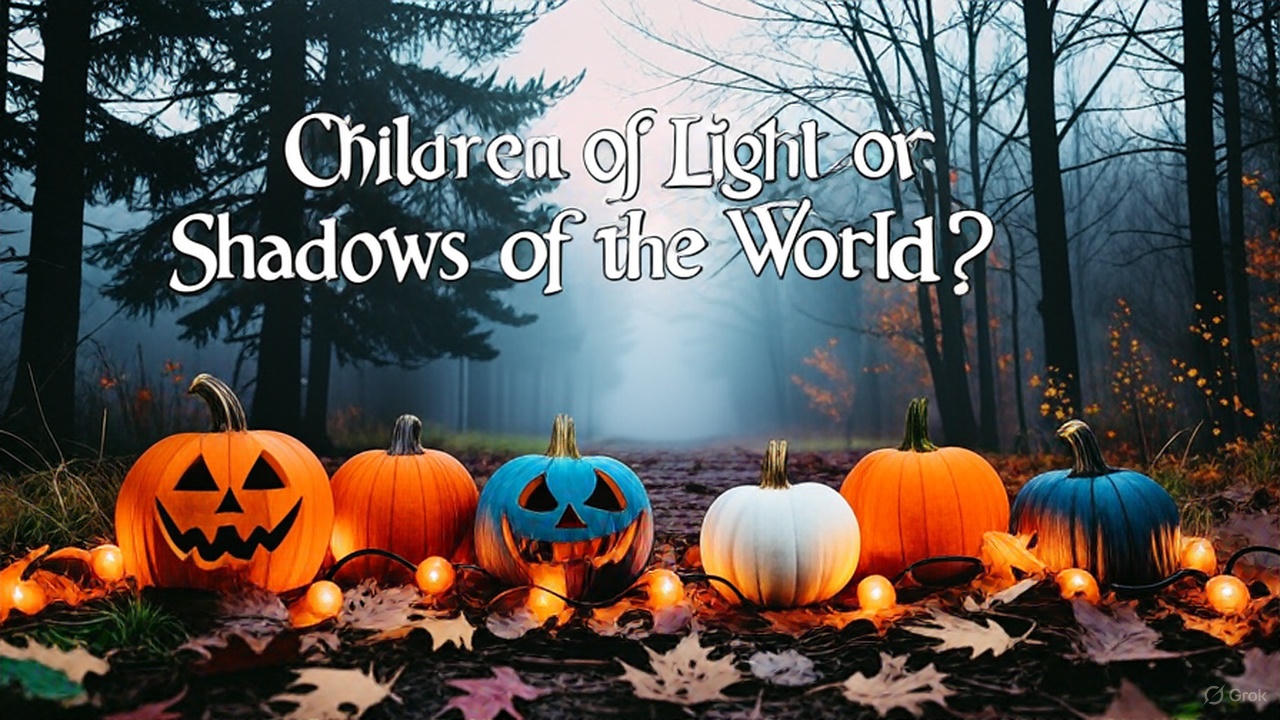
Why Christians Should Have No Part in Halloween
“And have no fellowship with the unfruitful works of darkness, but rather reprove them.” — Ephesians 5:11–12 (KJV)
Each year, millions of Christians participate in Halloween. Some call it “just harmless fun.” Others try to sanitize it through “trunk-or-treats” or “harvest festivals.”
But behind the costumes, candy, and laughter lies a dark history — one that is deeply rooted in paganism, death imagery, and false worship.
This article examines where Halloween came from, what it truly represents, and why God’s Word calls His people to stand apart from it.
The Pagan Roots of Halloween
Halloween’s origins go back over 2,000 years to the ancient Celtic festival of Samhain (pronounced sow-in).
It marked the end of the harvest and the beginning of winter — the season associated with death. The Celts believed that on the night of October 31, the veil between the living and the dead was thinnest. Spirits were thought to roam freely, visiting their old homes and causing mischief.
The Druids, Celtic pagan priests, built huge bonfires, offered animal sacrifices, and practiced divination to appease or communicate with these spirits.
Historians note that many of these rituals revolved around fear and appeasement — a far cry from biblical faith in the Lord of life.
(Source: Ronald Hutton, The Stations of the Sun, Oxford University Press, 1996; Britannica: “Samhain.”)
When the Roman Empire conquered Celtic lands, they merged Samhain with their own festivals honoring the dead, such as Feralia and the feast of Pomona, the goddess of fruit and fertility. Later, the Roman Catholic Church attempted to Christianize these celebrations by creating All Saints’ Day (Nov. 1) and All Hallows’ Eve (Oct. 31).
Yet many pagan practices — costumes, offerings, and divination — continued under new names.
This compromise was the beginning of what we might call spiritual syncretism — the blending of light and darkness.
The Symbols and Their Meanings
Modern culture has stripped Halloween’s imagery of its original meaning, but those roots still matter. Every symbol we see in today’s celebrations traces back to ancient rituals of fear, death, or false worship.
Jack-o’-Lanterns
The glowing pumpkin faces come from an old Irish legend of Stingy Jack, who tricked the devil and was doomed to wander the earth with a burning coal in a hollowed turnip.
The Celts originally carved grotesque faces into gourds or turnips to ward off evil spirits or house friendly ones during Samhain.
When Irish immigrants came to America, pumpkins became the preferred medium.
The image of light within darkness — meant to frighten or placate spirits — is a false imitation of the true Light of the world.
“And no marvel; for Satan himself is transformed into an angel of light.” — 2 Corinthians 11:14
Costumes and Masks
During Samhain, people wore animal hides and masks to disguise themselves from wandering spirits or blend in with them.
Romans adapted this practice in festivals to Pomona, and centuries later, it reappeared in “All Hallows Eve” celebrations, when children dressed as saints or angels.
Yet the underlying idea remained — to hide from spiritual danger through disguise, not through God’s protection.
“For ye were sometimes darkness, but now are ye light in the Lord: walk as children of light.” — Ephesians 5:8
Trick-or-Treating
This tradition has its roots in the medieval practices of “souling” and “guising.”
The poor went door to door offering prayers for the dead in exchange for food, and children performed tricks or songs for gifts. The “treat” was a reward; the “trick” was a threat of mischief if refused.
It reflects the appeasement of spirits rather than faith in God’s provision.
“The fear of man bringeth a snare.” — Proverbs 29:25
Witches, Ghosts, and Death Imagery
The celebration of witches and ghosts comes directly from Druidic belief that spirits of the dead roamed freely during Samhain.
Witches — priestesses who led these rituals — invoked nature gods and spirits for power and protection.
Modern Wiccans still regard Samhain as one of their eight sacred festivals.
Symbols like bats, skeletons, black cats, tombstones, and spiders were connected to death, the underworld, and demonic omens.
“Let us therefore cast off the works of darkness, and let us put on the armour of light.” — Romans 13:12
Other Pagan Elements
- Bonfires (literally “bone-fires”) were used to burn animal and sometimes human bones in sacrifice.
- Apples represented Pomona, the Roman goddess of fertility — bobbing for apples was a divination gamepredicting marriage and fate.
- Black and orange symbolized death and the dying sun.
- Owls and cats were viewed as spirit guides or familiars.
These are not neutral images — they were designed to honor false gods and channel fear of death into worship of spirits.
Testimonies from Those Who Came Out of Darkness
Many who once participated in witchcraft or the occult have since been saved — and they warn Christians not to take Halloween lightly.
Doreen Virtue, once a leading New Age teacher, now a born-again Christian, says:
“Halloween opens doors to darkness and fear — the opposite of the Holy Spirit.”
(Deceived No More, Thomas Nelson, 2020)
Jenny Weaver, a former witch now Christian worship leader, calls Halloween “a high holy day” in the occult world.
“When Christians celebrate Halloween, they’re participating in what I used to do to honor Satan.”
(Source: CBN Interview, 2019)
John Ramirez, an ex–Satanic priest turned evangelist, has said bluntly:
“Every time you dress up or celebrate, you’re bringing agreement with darkness.”
(Out of the Devil’s Cauldron, 2015; Charisma Magazine, 2018)
If those once enslaved by the very forces behind Halloween reject it completely, should not the children of God do the same?
Baalism and the Church’s Compromise
In Scripture, Baal (Hebrew lord, master) was not just one false god — it was a title used for many regional deities (e.g., Baal-Peor, Baal-Zebub).
Israel’s sin was not merely worshiping Baal, but lowering their view of the true God to the level of pagan idols.
“They have forsaken me… and have filled this place with the blood of innocents.” — Jeremiah 19:4–5
Today, many churches repeat Israel’s mistake by trying to “Christianize” darkness.
They rename Halloween “Harvest Festival,” “Trunk-or-Treat,” or “Light Night,” believing a new label removes the old meaning.
But God never told His people to redeem paganism — He told them to separate from it.
“What fellowship hath righteousness with unrighteousness? … come out from among them, and be ye separate.” — 2 Corinthians 6:14–17
Walking as Children of Light
Halloween is not harmless fun — it is a celebration of fear, death, and deception.
The Bible calls believers not to flirt with darkness, but to expose it and walk as children of light.
“Ye are all the children of light, and the children of the day: we are not of the night, nor of darkness.” — 1 Thessalonians 5:5–6
If you’ve participated out of ignorance, repent and turn from it. Replace the works of darkness with thanksgiving, praise, and the joy of Christ’s light.
We are not called to imitate the world, but to reveal the glory of the One who overcame it.
References and Sources
- Scripture: King James Version
- Historical Sources:
- Ronald Hutton, The Stations of the Sun (Oxford Univ. Press, 1996)
- Encyclopedia Britannica: “Samhain”
- History.com: “The History of Halloween”
- Catholic Encyclopedia: “All Saints’ Day”
- Testimonies:
- Doreen Virtue, Deceived No More (Thomas Nelson, 2020)
- John Ramirez, Out of the Devil’s Cauldron (2015)
- Jenny Weaver, CBN Interview (2019)
- Charisma Magazine: “Ex-Satanist Warns Christians About Halloween” (2018)
 unfeigned faith
Leave a comment